
Successor Liability: When a “New” Company Can Still Owe Old Commercial Debts Under California Law
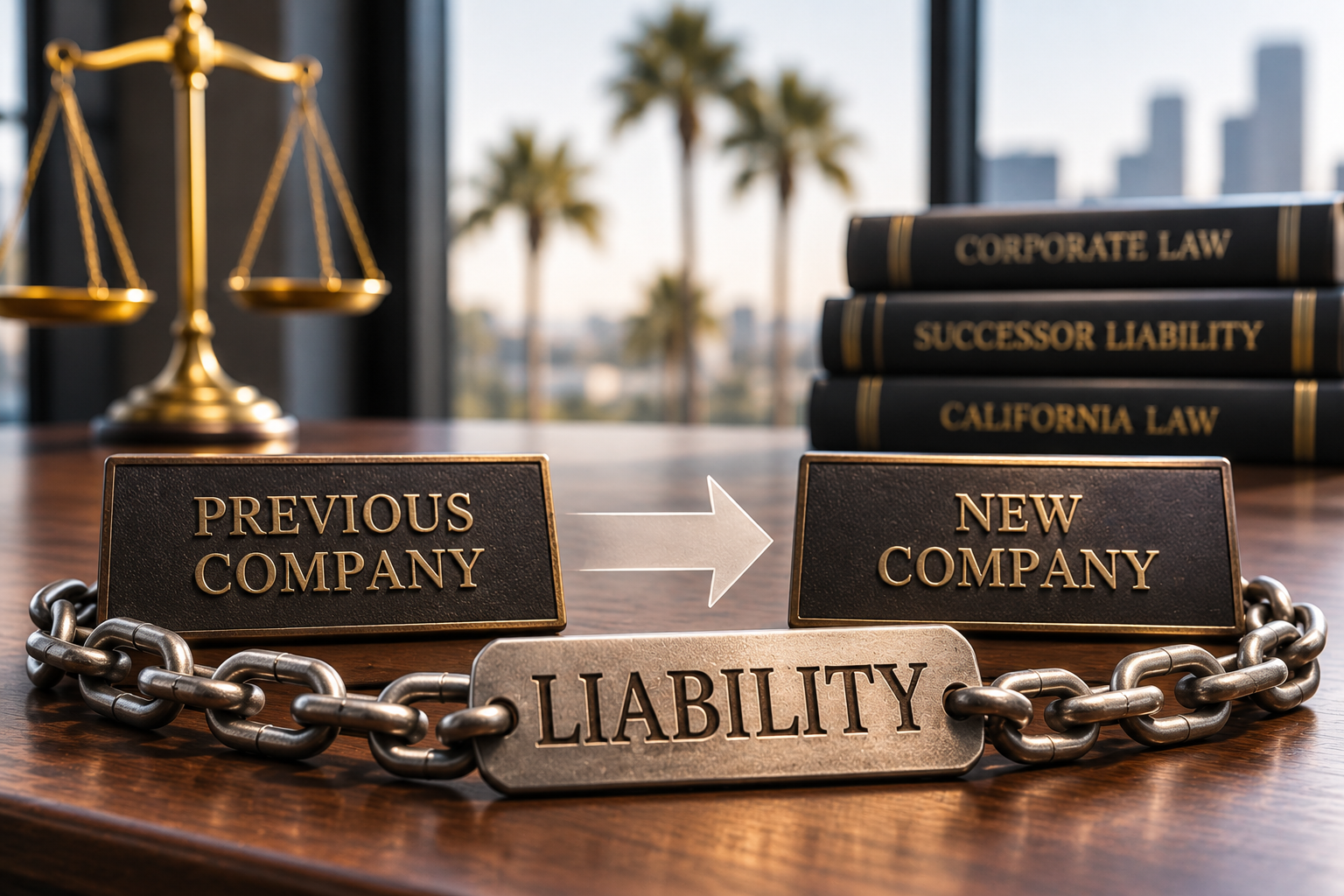
Under California law, a business that acquires assets or rebrands operations is generally not responsible for the seller’s unpaid commercial debts. That presumption can be overcome only in limited situations where the transaction preserves the same business in substance, such as continuity of ownership, control, or enterprise. In those cases, courts may treat the buyer as a successor and allow unpaid commercial obligations to follow the business despite formal changes in ownership.
Implications for commercial decision-makers:
- Most asset sales remain insulated from prior commercial debts.
- Formal transaction labels and entity structure are not determinative.
- Continuity and creditor impact drive successor exposure.
- Viability depends on fact-specific professional evaluation.
Why Asset Buyers Are Usually Not Responsible for Old Debts
California applies a strong presumption of non-liability when a company purchases assets rather than equity. Courts start from this baseline to protect legitimate transactions and routine business reorganizations.
- The default rule shields buyers from debts they did not assume.
- Asset sales allow businesses to change hands without importing legacy obligations.
- Unpaid commercial debt alone does not shift liability to a buyer.
- Successor liability exists as a narrow exception, not a general remedy.
This baseline explains why early evaluation matters and why creditors often consult a trusted collection attorney to assess whether an exception is plausible before committing resources.
When California Law Treats a Buyer as a Successor
The presumption of non-liability can give way only under recognized successor liability doctrines. Courts do not rely on deal labels. They examine the economic reality of what changed and what did not. California courts have articulated these successor liability principles through case law, including Ray v. Alad Corp., 19 Cal. 3d 22 (1977).
- Liability arises only under defined exceptions recognized by California courts.
- Judges look past structure to substance when assessing exposure.
- Continuity of the business, not acquisition alone, drives analysis.
- Multiple factors usually must align before liability is imposed.
Because these inquiries are narrow and fact-driven, businesses often seek context from counsel familiar with commercial collections and enforcement, including when it is appropriate to find a local collection attorney near you for early screening.
What Courts Mean by “Continuation of the Business”
Courts use the term “continuation” to describe whether the same enterprise effectively persists after a transaction.
- The inquiry examines operations, customers, the workforce, and branding together.
- Formal changes alone do not resolve the question.
- No single factor controls the outcome.
- The analysis depends on context and facts.
This concept explains why successor liability analysis resists simple rules and why outcomes vary across cases.
Why Ownership and Control Matter More Than Rebranding
Ownership and control receive heavy weight in successor liability analysis. Courts focus on who truly directs the business before and after the transaction.
- Overlapping ownership or management increases scrutiny.
- Control, not marketing or naming, signals continuity.
- Insider or related-party transactions are subject to closer examination.
- Independent buyers generally face lower successor exposure.
These factors often intersect with timing considerations, including whether a claim remains within the statute of limitations on debt in California. Temporal context informs evaluation but does not convert analysis into a procedural checklist.
Limits That Often Constrain Successor Liability Claims
Successor liability is not a default solution for unpaid commercial debts. Courts apply it cautiously to avoid chilling legitimate commerce.
- Adequate consideration and buyer independence constrain exposure.
- Operating in the same industry is not enough.
- Similar customers or services do not establish continuity on their own.
- Many claims fail despite nonpayment.
These limits underscore why successor liability remains the exception and careful screening is essential.
How the Law Offices of Stuart A. Katz, P.C., Evaluate These Matters
In practice, the Law Offices of Stuart A. Katz, P.C., evaluate successor liability issues through a judgment-driven lens rather than a mechanical test, drawing on the perspective of an experienced debt collection lawyer focused on commercial enforcement realities.
- The firm assesses whether continuity of ownership, control, or enterprise meaningfully outweighs formal separation.
- Fact density and evidentiary alignment are weighed early to gauge enforcement viability.
- Enforcement risk, cost exposure, and timing shape whether a matter warrants further pursuit.
- Weak factual alignment often makes continued enforcement inefficient or unjustified.
- Each evaluation is context-specific and grounded in professional judgment, not theory alone.
For business creditors, this type of evaluation clarifies whether an apparent “new” company presents a realistic enforcement target or whether the separation between entities is likely to hold. In many commercial matters, surface continuity exists without the legal substance required to support successor liability.
From an enforcement standpoint, this analysis helps avoid misdirected effort and expense. It distinguishes situations in which successor theories meaningfully alter leverage from those in which unpaid debts remain insulated despite frustration or nonpayment.
Common Questions About Successor Liability
Can unpaid commercial debts follow a business after an asset sale in California?
Yes, but only in limited circumstances. Courts allow debts to follow a business only when successor liability principles apply, and continuity is established. Asset sales alone do not transfer liability.
Does forming a new entity or changing the business name eliminate prior debts?
No. Courts focus on continuity of ownership, control, and enterprise. Naming changes and new entities do not control the analysis.
Are successor liability claims common in commercial collections matters?
They are relatively uncommon and highly fact-specific. Most claims fail in the absence of strong indicators of continuity that overcome the default rule of non-liability.
Evaluating Whether a “New” Company Is Truly New
California successor liability analysis focuses on substance rather than form. Most asset sales and restructurings remain insulated from prior commercial debts, but certain situations exist where continuity of ownership, control, or enterprise justifies treating a buyer as the same business for enforcement purposes.
From an enforcement standpoint, the Law Offices of Stuart A. Katz, P.C., evaluate these matters as judgment-driven assessments rooted in risk, cost, and collectability, not assumptions or outcome guarantees. This analysis clarifies whether successor liability meaningfully alters leverage or whether formal separation is likely to control.